
Best Android Phones are not simply the models with the highest price tags or the longest specification sheets. The right Android smartphone should match your budget, daily usage, camera expectations, gaming needs, battery requirements, and preference for software support.
India’s Android market gives buyers a wide range of choices, from affordable everyday phones to premium flagships, foldables, gaming-focused devices, and camera-centric smartphones. That variety is useful, but it can also make choosing a phone confusing.
Instead of focusing on one temporary list of models, this guide explains how to identify the best Android phone for your needs. You will learn what specifications actually matter, which features deserve priority, what compromises are reasonable at different price levels, and what to check before spending your money.
What Makes an Android Phone One of the Best?
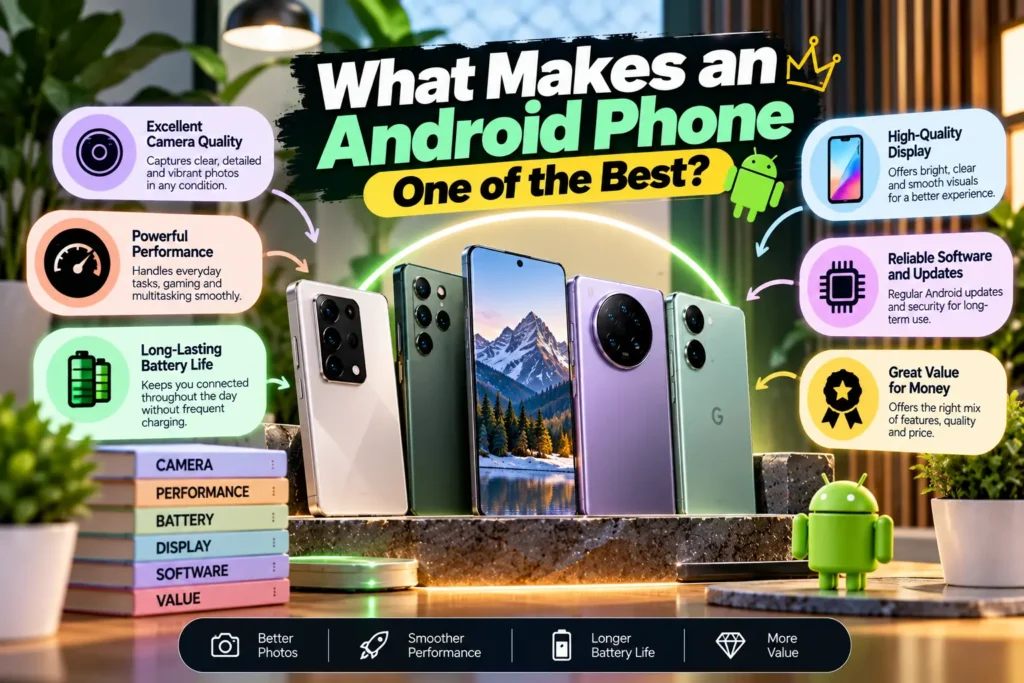
A great Android phone combines reliable performance, a quality display, dependable battery life, useful cameras, stable software, and appropriate long-term support.
The “best” phone therefore depends heavily on the buyer. A mobile gamer may prioritize the processor and cooling system, while someone who regularly takes photos may care more about camera consistency and image processing.
The strongest overall Android phones generally perform well in these areas:
- Smooth everyday performance
- Bright and responsive display
- Reliable primary camera
- Good battery endurance
- Fast and secure unlocking
- Stable Android software
- Useful software and security updates
- Good connectivity
- Suitable storage capacity
- Dependable build quality and after-sales support
A phone does not need to lead every category. It needs to perform particularly well in the areas that matter most to you.
Best Android Phones by User Type
The easiest way to shortlist an Android smartphone is to start with your main use case rather than a brand name.
| User Type | Features to Prioritize | Lower-Priority Features |
|---|---|---|
| Everyday user | Battery, display, software, reliability | Extreme gaming performance |
| Gamer | Powerful chipset, cooling, display, battery | Telephoto camera |
| Photographer | Main camera, stabilization, processing | Maximum charging speed |
| Student | Battery, storage, durability, value | Premium materials |
| Business user | Security, software support, battery | Gaming-focused features |
| Content creator | Cameras, storage, display, microphones | Decorative design features |
| Premium buyer | Cameras, performance, display, build | Lowest possible price |
Once you know your priorities, comparing phones becomes much easier.
Start With Your Budget
Set a realistic spending limit before comparing smartphones. This prevents attractive but unnecessary features from pushing you toward a phone that costs considerably more than you intended.
The Indian smartphone market can broadly be approached through four buying levels.
Budget Android Phones
Budget smartphones are designed for essential activities such as calling, messaging, social media, online classes, UPI apps, browsing, and video streaming.
Prioritize basic reliability over impressive-looking specifications. A balanced processor, sufficient memory, usable storage, good battery life, and a decent screen are more important than having several weak rear cameras.
Mid-Range Android Phones
The mid-range segment often offers an appealing balance between performance and price.
Depending on the model, you can find AMOLED displays, high refresh rates, 5G connectivity, capable cameras, faster charging, better processors, stereo speakers, and improved build quality without paying flagship prices.
This category can suit students, professionals, casual gamers, and everyday users particularly well.
Upper Mid-Range Phones
Moving further up usually brings stronger processors, improved cameras, more refined software experiences, better displays, premium construction, and additional features such as optical image stabilization.
However, improvements are not always proportional to the price increase. Compare the features you will actually use.
Premium and Flagship Android Phones
Flagships focus on high-end performance, advanced camera systems, premium displays, strong construction, and additional features such as wireless charging or enhanced water resistance on supported models.
They can make sense for people who keep phones for several years, rely heavily on mobile photography or video, play demanding games, or simply want a premium experience.
Check the Processor Before Buying
The processor, or system-on-chip, has a major influence on how fast and responsive an Android smartphone feels.
It affects app loading, gaming, image processing, video recording, artificial intelligence features, connectivity, and power efficiency.
Qualcomm Snapdragon and MediaTek Dimensity chips are common across Android devices, while some manufacturers also use their own or other processor families.
Do not judge a processor purely by its name or core count. Look at independent reviews of the exact phone because cooling, software optimization, memory, and thermal limits can substantially affect real-world performance.
How Much Performance Do You Need?
For WhatsApp, YouTube, browsing, banking apps, calls, and social media, you usually do not need a flagship processor.
For demanding mobile games, heavy multitasking, high-resolution video editing, or long-term performance headroom, a stronger chipset becomes more valuable.
The best choice is enough performance for your actual workload with some room for future apps and software updates.
RAM and Storage Matter More Than Many Buyers Think
Adequate RAM helps apps run smoothly and improves multitasking, while internal storage determines how much room you have for apps, games, photos, videos, and offline files.
For many buyers, 128GB is a practical starting point, especially if the phone does not include expandable storage. Heavy gamers, content creators, and people who record lots of video may benefit from 256GB or more.
Do not focus exclusively on capacity. Faster storage technology can also improve app installation, loading, file transfers, and general responsiveness.
Check whether the phone has a microSD slot if expandable storage is important to you.
Choose the Right Display
The screen is one of the most frequently used parts of a smartphone, so display quality deserves serious attention.
AMOLED and OLED panels can provide deep blacks, strong contrast, and attractive colours. LCD panels can still be perfectly suitable on more affordable devices when they are well implemented.
Refresh Rate
A higher refresh rate can make scrolling and animations appear smoother. Many modern Android phones offer 90Hz, 120Hz, or similar high-refresh-rate displays.
However, refresh rate alone does not determine screen quality.
Also consider:
- Outdoor brightness
- Resolution and sharpness
- Colour accuracy
- Touch responsiveness
- Viewing angles
- HDR support where relevant
- Display protection
- Automatic brightness behaviour
For Indian users who frequently use their phones outdoors, usable sunlight visibility can be particularly valuable.
Do Not Judge Cameras by Megapixels Alone
A larger megapixel number does not automatically produce better photos.
Camera performance depends on the sensor, lens quality, aperture, optical stabilization, autofocus, image processing, HDR performance, and software tuning.
A well-optimized lower-resolution camera can outperform a poorly implemented high-megapixel camera.
Main Camera
The primary camera is usually the most important. Check how it performs during daylight, indoors, at night, and with moving subjects.
Look for natural skin tones, controlled highlights, useful dynamic range, accurate focus, and consistent processing.
Ultrawide and Telephoto Cameras
An ultrawide camera is useful for landscapes, buildings, groups, and tight spaces.
A dedicated telephoto camera can provide better optical zoom than relying entirely on digital cropping. It is more common on higher-priced devices.
Do not assume that a phone with more cameras has a better camera system. A strong main camera is generally more valuable than multiple low-quality secondary sensors.
Video Recording
If you record videos regularly, examine stabilization, microphone performance, autofocus, supported resolutions, frame rates, and consistency between lenses.
Creators should also consider storage requirements because high-quality video can consume space quickly.
Battery Life Should Match Your Routine
Battery capacity matters, but it does not tell the entire story.
Processor efficiency, display technology, refresh rate, network usage, software optimization, brightness, gaming, navigation, and background apps all influence actual endurance.
A phone with a larger battery can sometimes last less than another device with a smaller battery if its hardware or software consumes more power.
For realistic comparisons, look at reputable reviews that test complete devices under similar conditions.
Fast Charging
Fast charging is useful when you need to recharge quickly before school, work, travel, or an outing.
Check whether the required charger is included in the retail box. Some manufacturers sell chargers separately.
Very high advertised charging wattage should not automatically outweigh battery endurance, software quality, cameras, or overall reliability.
Software Experience Is Extremely Important
Hardware specifications attract attention, but software determines how you interact with your phone every day.
Different Android manufacturers customize the operating system with their own interfaces, apps, settings, features, and visual designs.
Consider:
- Update policy
- Security update commitment
- Pre-installed applications
- Advertisements or promotional notifications
- Privacy controls
- Customization options
- Stability
- Useful productivity features
If you plan to keep a smartphone for several years, longer software support can be more valuable than a minor hardware advantage.
Before buying, verify the manufacturer’s current update policy for that exact model because support periods can differ between devices.
5G Connectivity in India
For buyers planning to keep their phones for several years, 5G support is worth considering.
However, simply seeing “5G” on the box is not enough. Network compatibility depends on the modem, supported bands, carrier network, location, plan, and local coverage.
Also check practical connectivity features such as dual-SIM support, Wi-Fi capabilities, Bluetooth version, NFC if you need it, USB connectivity, and eSIM support where applicable.
Build Quality and Durability
A smartphone is carried, handled, charged, and used repeatedly every day. Durability therefore deserves more attention than it often receives.
Premium materials can feel attractive, but practical protection may matter more.
Check for:
- Water and dust resistance rating, if provided
- Display protection
- Frame and back material
- Camera lens protection
- Case availability
- Repair options
- Service centre accessibility
Remember that an IP rating does not mean a phone is indestructible or suitable for every type of water exposure. Manufacturer warranty terms should always be checked.
Fingerprint Sensor and Face Unlock
Biometric authentication can affect daily convenience because you may unlock your phone dozens of times per day.
Android smartphones may use side-mounted, rear-mounted, optical in-display, or ultrasonic fingerprint sensors depending on the device.
Speed is useful, but reliability matters more. A fingerprint sensor that works consistently is preferable to one that is technically advanced but inconsistent.
Face unlock capabilities also vary significantly between devices, particularly in the level of security they provide. Check the manufacturer’s documentation before using biometric authentication for sensitive purposes.
Gaming Performance: What Should You Check?
The best Android phones for gaming need more than a powerful processor.
Sustained performance matters because a phone may initially run a game quickly but reduce performance as heat builds up.
Gamers should consider:
- Chipset performance
- Thermal management
- Stable frame rates
- Touch response
- Display refresh rate
- Battery endurance
- Charging speed
- Speaker quality
- Storage capacity
Independent long-duration gaming tests are more useful than a single benchmark score.
Best Android Phones for Photography: What Matters?
For photography, prioritize consistency rather than impressive specifications on paper.
A useful camera phone should produce dependable results across different situations, including daylight, indoor lighting, portraits, low-light scenes, and video.
Optical image stabilization can be particularly useful for reducing unwanted movement in certain shooting conditions. Camera processing should also handle skin tones, shadows, highlights, and colours naturally.
If zoom photography matters to you, investigate whether the phone has a dedicated telephoto lens rather than relying mainly on digital zoom.
After-Sales Service Matters in India
A phone can look excellent on paper but become frustrating if repairs, spare parts, or service centres are difficult to access.
Before choosing between closely matched phones, check the manufacturer’s service availability in your city or region.
You should also review:
- Warranty duration and terms
- Authorized service locations
- Repair process
- Spare-part availability
- Customer support channels
This becomes increasingly important if you plan to use the phone for three or more years.
Common Mistakes When Buying an Android Phone
Avoiding a few common mistakes can significantly improve your buying decision.
Choosing Based Only on Megapixels
Camera resolution is only one part of image quality. Sensor quality, stabilization, optics, processing, and autofocus matter too.
Buying the Highest RAM Number
More RAM can help, but it cannot compensate for a weak processor, poor software optimization, or slow storage.
Ignoring Software Updates
A smartphone is a long-term connected device. Security and operating-system support deserve consideration alongside hardware.
Paying for Features You Will Never Use
A dedicated gaming system, extreme zoom, foldable display, stylus, or ultra-fast charging may be valuable for one person and unnecessary for another.
Buying Without Checking Independent Reviews
Specifications tell you what hardware is included. Reviews can reveal heating, battery endurance, camera consistency, display visibility, software issues, and real-world performance.
How to Choose the Best Android Phone in India
Use a simple process rather than comparing dozens of specifications simultaneously.
- Set your maximum budget.
- Decide your three most important features.
- Shortlist three to five phones within that price range.
- Compare processors, RAM, storage, displays, cameras, and batteries.
- Check software and security update policies.
- Read or watch independent long-term and real-world reviews.
- Check service support and warranty terms.
- Compare the final price across reputable sellers.
- Confirm the exact RAM/storage variant before ordering.
This approach helps separate genuinely useful features from marketing claims.
Should You Buy Online or Offline?
Both options can work well, depending on the deal and your preferences.
Online shopping makes price and specification comparisons convenient and may provide access to promotional discounts. Offline stores let you physically inspect the phone, evaluate its size and display, and discuss local service or exchange options.
Regardless of where you buy, confirm the seller’s credibility, warranty status, return conditions, model number, and storage variant before payment.
For expensive smartphones, reading the return and replacement policy before ordering is particularly important.
Frequently Asked Questions
1. Which Android phone is best in India?
There is no single Android phone that is best for every buyer. The right choice depends on your budget and priorities. Compare performance, display quality, cameras, battery endurance, software support, storage, durability, and after-sales service, then choose the model that performs strongly in the areas you use most.
2. How much RAM is good for an Android phone?
RAM requirements depend on your usage and the phone’s software optimization. For ordinary communication, browsing, video, and social apps, moderate RAM capacity can be sufficient. Gamers and heavy multitaskers may benefit from additional memory. Do not evaluate RAM alone; processor performance and storage speed also influence responsiveness.
3. Is 128GB storage enough for a smartphone?
For many users, 128GB can provide a practical balance between price and available space. However, large games, offline movies, high-resolution photos, and frequent video recording can fill it faster. If you create lots of content or plan to keep the phone for years, 256GB may offer greater flexibility.
4. Should I buy a 5G Android phone in India?
A 5G phone can be a sensible choice if compatible coverage and plans are available where you use the device, especially if you intend to keep it for several years. Check supported network bands and carrier compatibility rather than relying only on a 5G label. Actual network performance varies by location and provider.
5. What should I check before buying an Android phone?
Start with your budget, processor, RAM, storage, display, camera performance, battery endurance, charging, connectivity, software support, durability, warranty, and service availability. Then check independent reviews for real-world performance. Confirm the exact model and storage variant before purchasing because specifications can differ between versions.
Conclusion
Choosing among the Best Android Phones in India becomes easier when you stop searching for one universally perfect device and start matching features to your own needs.
Begin with a clear budget and decide whether performance, cameras, battery life, display quality, gaming, software support, or durability matters most. Compare a small shortlist using real-world reviews rather than relying solely on specification sheets or promotional claims.
For most buyers, a balanced smartphone with dependable performance, sufficient storage, strong battery endurance, a good primary camera, and meaningful software support will provide better long-term value than a device built around one headline feature.
Before purchasing, compare current prices, verify the exact variant, review the manufacturer’s update commitment, and check warranty and service availability in your area. That final check can help you choose an Android phone that remains useful well beyond the first few months.