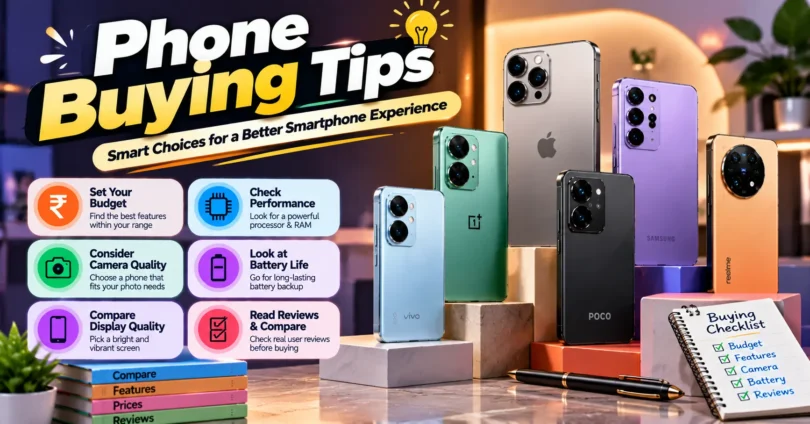

Phone Buying Tips can help you avoid spending money on features you do not need while making sure your next smartphone performs well for everyday use. With phones available across multiple price ranges in India, choosing the right device requires more than comparing camera megapixels or looking at the biggest specification numbers.
A good smartphone should match your budget, daily usage, performance needs, camera expectations, battery requirements, preferred display size, storage needs, and expected ownership period.
These Phone Buying Tips explain exactly what to check before buying a smartphone in India. Whether you need a phone for studies, gaming, photography, work, social media, entertainment, or basic everyday tasks, this guide will help you make a more informed decision.
Why Are Phone Buying Tips Important?
Phone Buying Tips are important because smartphone specifications can look impressive without necessarily improving your actual experience. Understanding which features matter helps you spend your budget where it makes the biggest difference.
Two phones at a similar price can provide completely different experiences. One may offer stronger gaming performance, while another focuses on cameras, battery life, or display quality.
Before buying, consider:
- Your maximum budget
- Android or iOS preference
- Processor performance
- RAM and storage
- Camera quality
- Battery capacity and efficiency
- Charging capabilities
- Display quality
- Software experience
- Update policy
- 5G and connectivity
- Build quality
- Warranty and after-sales support
Prioritizing these factors makes comparing phones much easier.
Set Your Budget Before Comparing Smartphones

One of the most practical Phone Buying Tips is to decide your maximum budget before looking at individual models.
Without a fixed budget, it is easy to move from an affordable phone to a much more expensive model because every small upgrade appears attractive.
Indian smartphone buyers can find devices across budget, mid-range, premium mid-range, and flagship categories.
| Phone Category | Generally Suitable For | Main Priorities |
|---|---|---|
| Entry-level | Basic users | Calls, messaging, light apps |
| Budget | Students and everyday users | Battery, display, value |
| Mid-range | Most mainstream buyers | Balanced overall experience |
| Premium mid-range | Power users | Performance, camera, display |
| Flagship | Enthusiasts and professionals | Premium features and performance |
Prices vary considerably between models and promotions, so treat these categories as general guidance rather than fixed price brackets.
Understand How You Actually Use Your Phone
Before comparing specifications, identify your main smartphone activities.
Someone who mainly uses WhatsApp, YouTube, Instagram, online payments, web browsing, and calls has very different requirements from someone playing demanding games or recording videos professionally.
For Basic Everyday Users
Focus on battery life, software stability, adequate storage, a comfortable display, and reliable performance.
For Gamers
Give greater importance to the processor, GPU performance, thermal management, RAM, display refresh rate, touch responsiveness, and battery endurance.
For Photography Lovers
Look beyond megapixels. Consider sensor quality, image processing, optical image stabilization where available, lens selection, low-light results, portrait processing, and video quality.
For Students
Battery life, storage, display quality, software reliability, and overall value are generally more important than premium design features.
Understanding your usage is one of the easiest ways to narrow down your options.
Choose the Right Processor
A processor, or system-on-chip, influences how quickly and efficiently a smartphone handles apps, games, cameras, connectivity, and other tasks.
Popular smartphone chip families include Qualcomm Snapdragon, MediaTek Dimensity, Apple A-series chips, Google Tensor, and Samsung Exynos.
However, the brand name alone does not tell you how fast a particular processor is.
How Much Performance Do You Need?
Basic users generally do not require a flagship processor.
For calling, messaging, social media, video streaming, navigation, and regular apps, a capable modern mid-range chipset can provide a smooth experience.
Gaming, high-resolution video editing, demanding multitasking, and other intensive workloads benefit more from powerful processors.
Among the most useful Phone Buying Tips is to compare real-world performance within your budget rather than assuming that every newer or higher-numbered processor is automatically better.
Check RAM Based on Your Usage
RAM helps smartphones keep apps and processes readily accessible while you use the device.
More RAM can help with multitasking, but RAM capacity should not be considered independently from processor performance and software optimization.
For lighter use, moderate RAM may be sufficient. Heavy multitasking, gaming, content creation, and demanding applications can benefit from additional memory.
Avoid selecting a phone simply because its marketing highlights a large RAM number. Overall performance depends on several components working together.
Choose Enough Internal Storage
Storage deserves serious attention because apps, photos, videos, games, offline downloads, and system files can consume significant space over time.
Many modern smartphones do not offer expandable microSD storage, making your initial choice more important.
Which Storage Capacity Should You Choose?
For light users who rely heavily on streaming and cloud storage, a lower capacity may be sufficient.
For most buyers, choosing enough storage for several years of apps, photos, videos, and downloads is more practical.
Heavy gamers, creators, photographers, and people recording large amounts of video should consider higher storage capacities.
One of the smartest Phone Buying Tips is to check your current phone’s storage usage before choosing your next device.
Do Not Judge a Camera Only by Megapixels
A higher megapixel count does not automatically mean better photographs.
Smartphone camera quality depends on multiple factors, including sensor characteristics, lens quality, image processing, stabilization, HDR performance, autofocus, and software.
What Should You Check in a Phone Camera?
Pay attention to:
- Main camera quality
- Ultra-wide camera performance
- Telephoto or optical zoom capability
- Optical image stabilization where available
- Low-light performance
- Portrait quality
- Front camera performance
- Video stabilization
- Video resolution and frame-rate options
- Camera processing consistency
Sample photos and trustworthy camera comparisons are more useful than megapixel numbers alone.
Check Display Quality Carefully
You interact with the display every time you use your phone, making it one of the most important components.
Display technology, resolution, brightness, refresh rate, colour reproduction, size, and outdoor visibility can all affect your experience.
AMOLED vs LCD
AMOLED and OLED displays can provide deep blacks and strong contrast because individual pixels can produce their own light.
LCD screens use a backlight and can still provide a good experience when implemented well.
Do not choose a display purely by panel type. Brightness, calibration, resolution, responsiveness, and overall quality also matter.
Is a Higher Refresh Rate Worth It?
A higher refresh rate can make scrolling, supported animations, and compatible games appear smoother.
Displays with refresh rates above the traditional 60Hz experience have become common across many smartphone categories.
However, refresh rate should not be your only priority. A high-refresh-rate display with poor brightness or colour reproduction may provide a worse overall experience than a well-tuned alternative.
Check whether the phone manages refresh rate efficiently, as display settings can also affect battery consumption.
Battery Life Should Match Your Routine
Among all Phone Buying Tips, battery life is especially important for Indian users who spend long periods away from a charger.
Battery capacity is commonly measured in milliampere-hours (mAh), but capacity alone cannot tell you exactly how long a phone will last.
Actual endurance depends on:
- Processor efficiency
- Display size and brightness
- Refresh rate
- Mobile network conditions
- Software optimization
- Gaming
- Camera use
- GPS and navigation
- Background applications
- Personal usage patterns
Therefore, consider both battery capacity and independent real-world battery testing when possible.
Consider Charging Speed and Convenience
Fast charging can be useful if you regularly need to recharge your phone during a busy day.
However, charging speed should be considered alongside battery endurance, charger availability, charging standards, and thermal management.
Also check whether the required charger is included in the retail box. Some manufacturers sell charging adapters separately.
Wireless charging may be useful for premium-phone buyers, but it is not essential for everyone.
Check 5G Support in India
5G compatibility is increasingly relevant when purchasing a smartphone you expect to keep for several years.
However, simply seeing “5G” on a product page is not enough.
Check the device’s network compatibility and whether it works appropriately with the bands and services used by your preferred Indian telecom operator.
Real-world 5G availability and performance can vary according to network provider, plan, location, signal quality, and congestion.
Android vs iPhone: Choose the Platform First
Choosing between Android and iOS can significantly reduce the number of phones you need to compare.
Choose Android If You Prefer
Android offers devices across a wide range of budgets, brands, designs, hardware combinations, and software experiences.
It can be a strong choice if you value variety and want more options at different price points.
Choose iPhone If You Prefer
Apple’s iPhones combine iOS with Apple’s hardware and services. They may particularly appeal to people already using products such as Mac, iPad, Apple Watch, or AirPods.
Neither platform is automatically right for every person. Choose according to your preferred apps, ecosystem, budget, features, and workflow.
Check the Software Update Policy
Software support is one of the most overlooked Phone Buying Tips.
A phone can have excellent hardware at launch but become less attractive for long-term ownership if its software support is limited.
Before buying, check the manufacturer’s official update policy for that specific model or series.
Longer support can provide access to newer operating-system features and security updates for a greater portion of the phone’s useful life.
This matters particularly if you intend to keep your smartphone for several years.
Do Not Ignore Software Experience
Hardware specifications tell only part of the story.
Two smartphones with similar processors, RAM, and displays can feel different because of their software.
Check whether you prefer the manufacturer’s interface and features. Also consider pre-installed applications, customization options, update reliability, notification behaviour, privacy controls, and general usability.
A clean, responsive software experience can sometimes matter more in everyday use than a minor hardware advantage.
Check Build Quality and Durability
Your smartphone may be used every day for several years, so physical durability deserves attention.
Consider the frame material, front and rear protection, water and dust resistance where officially rated, button quality, weight, thickness, and overall construction.
Premium materials can feel better, but they are not always necessary.
Most buyers should still consider using a good protective case and screen protection according to their needs.
Check Service Centres and Warranty
After-sales service is an important factor when buying a smartphone in India.
Before selecting an unfamiliar brand or model, check whether authorized service support is reasonably accessible in your area.
Also read the warranty terms rather than assuming every type of damage is covered.
Reliable after-sales support becomes particularly important if you plan to keep the device for several years.
Compare Online and Offline Prices
Another useful Phone Buying Tip is to compare the final purchase cost across reputable online and offline sellers.
Smartphone pricing can change during promotions, seasonal sales, bank offers, exchange programs, and retailer-specific campaigns.
Do not look only at the advertised discount.
Compare the final amount you actually have to pay, warranty conditions, seller credibility, return terms, and any bundled benefits.
A slightly higher price from a trustworthy seller can sometimes be more sensible than an unusually cheap offer from an uncertain source.
Should You Buy a New, Used, or Refurbished Phone?
New smartphones are generally the easiest option because their condition and warranty arrangements are clearer.
Used and refurbished devices can reduce costs, but they require more careful inspection.
Before buying a used phone, check:
- Battery condition
- Display and touchscreen
- Cameras
- Speakers and microphone
- Charging port
- Physical damage
- Buttons
- Wi-Fi and Bluetooth
- Mobile network functionality
- Device identity and activation status
- Available invoice or warranty information
Buy from a trustworthy seller and understand the return policy before paying.
Common Smartphone Buying Mistakes to Avoid
Even experienced buyers can make mistakes when comparing phones.
One mistake is buying according to specification numbers rather than real requirements. More RAM, more megapixels, or faster charging does not automatically make one phone better overall.
Another mistake is spending too much on performance that will never be used.
Buyers should also avoid ignoring software support, service availability, storage requirements, device size, and long-term battery needs.
Following sensible Phone Buying Tips helps you focus on the complete user experience instead of marketing numbers.
Quick Phone Buying Checklist
Before placing your order, confirm these points:
- Set your maximum budget.
- Decide between Android and iOS.
- Identify your main use cases.
- Compare processor performance.
- Select sufficient RAM and storage.
- Check real camera performance.
- Compare display quality and brightness.
- Review battery endurance and charging.
- Confirm 5G and connectivity support.
- Check the software update policy.
- Consider build quality and durability.
- Verify warranty and service availability.
- Compare final prices from reputable sellers.
This checklist can prevent many common buying mistakes.
Frequently Asked Questions
What are the most important Phone Buying Tips?
The most important Phone Buying Tips are to set a budget first, identify your main usage, and then compare processor performance, camera quality, battery life, display, storage, software support, connectivity, and after-sales service. Avoid choosing a phone purely because one specification looks better than its competitors.
How much RAM is good for a smartphone?
The right amount of RAM depends on your operating system, apps, processor, and usage pattern. Light users need less memory than gamers and heavy multitaskers. Instead of buying according to RAM numbers alone, check how the phone performs in real-world multitasking and whether its processor and software are well optimized.
How much storage should I choose when buying a phone?
Choose enough storage for your apps, photos, videos, games, and future requirements. Check how much storage your current device uses before deciding. If the new phone lacks microSD expansion and you intend to keep it for several years, paying for additional internal storage may prevent future space problems.
What should I check before buying a 5G phone in India?
Check whether the smartphone supports 5G connectivity appropriate for your preferred Indian network, along with its processor, battery efficiency, software support, and overall value. Do not buy a weak phone solely because it advertises 5G. Network availability and real-world speeds can also vary by carrier and location.
Should I buy a phone online or from an offline store?
Both options can work well. Online stores may provide convenient price comparisons and promotions, while physical stores allow you to handle the phone before buying and may offer immediate assistance. Compare the final price, warranty, seller reputation, return conditions, exchange value, and available offers before choosing either option.
Conclusion
Following practical Phone Buying Tips makes choosing a smartphone much easier. Instead of chasing the biggest specification numbers, focus on how the device will fit into your daily routine.
Start with a clear budget and identify your main use. Then compare the processor, RAM, storage, cameras, display, battery life, charging, software support, 5G connectivity, durability, warranty, and after-sales service.
The best smartphone is not automatically the newest or most expensive one. It is the phone that provides the right combination of features, reliability, performance, and value for your requirements.
Before purchasing, shortlist two or three models within your budget and compare them using these Phone Buying Tips. This final comparison can help you avoid unnecessary spending and choose a smartphone you will be comfortable using for years.