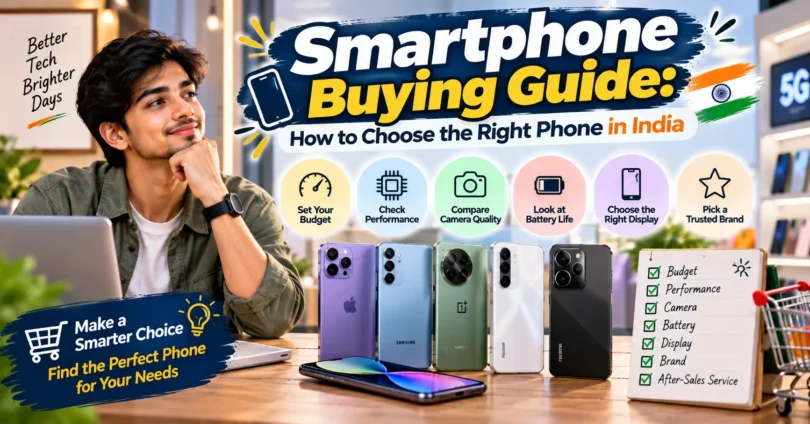

Smartphone Buying Guide decisions become much easier when you know which specifications actually matter and which features are mostly marketing. A good smartphone should match your budget, daily usage, preferred software, camera expectations, battery needs, and how long you plan to keep the device.
For buyers in India, the choice can be especially confusing because phones are available across almost every price range. Two smartphones with similar prices may offer completely different strengths: one may have a better camera, while another provides stronger gaming performance, longer battery life, or better software support.
This guide explains the important factors you should check before spending your money, including processor performance, RAM, storage, display, cameras, battery, charging, 5G connectivity, durability, software updates, and after-sales support.
Start With Your Budget and Actual Needs

Before comparing processors or camera megapixels, decide how much you are comfortable spending and what you actually need from the phone.
Your usage pattern matters more than simply buying the model with the longest specification sheet.
For example, a student who mainly uses WhatsApp, YouTube, social media, online classes, UPI apps, and light games may not need an expensive flagship processor. A mobile gamer or content creator, however, may benefit significantly from stronger hardware.
Ask yourself:
- What is my maximum budget?
- Do I play demanding mobile games?
- Is photography important to me?
- Do I need all-day or multi-day battery life?
- How much storage will I realistically use?
- Do I prefer Android or iOS?
- How many years do I expect to keep the phone?
- Do I need features such as NFC, eSIM, stereo speakers, or water resistance?
Answering these questions will immediately reduce the number of suitable options.
Choose the Right Smartphone Price Segment
There is no single ideal budget for every smartphone buyer. Instead, focus on the features available within your chosen price category.
Budget Smartphones
Budget devices are generally suitable for calls, messaging, social media, video streaming, digital payments, web browsing, and everyday applications.
When shopping in this category, prioritize a reliable processor, sufficient RAM and storage, good battery life, and a usable display rather than secondary features you may rarely use.
Mid-Range Smartphones
The mid-range segment is often attractive for users who want a balance of performance, camera quality, battery life, display quality, and modern connectivity.
Features such as AMOLED displays, high refresh rates, 5G, faster charging, optical image stabilization, and stronger processors are commonly found as prices increase.
However, specifications vary considerably between models, so compare the complete package rather than assuming a higher price guarantees a better experience.
Premium and Flagship Smartphones
Premium phones usually focus on high-end processors, advanced cameras, better build quality, premium displays, stronger water resistance, wireless charging on some models, and longer software support.
They make more sense for users who can genuinely benefit from these improvements or plan to keep their smartphone for several years.
Check the Processor Before Buying
The processor, or system-on-chip (SoC), is one of the most important components of a smartphone. It influences overall speed, gaming performance, camera processing, connectivity, power efficiency, and AI-related features.
Popular mobile chip families include Qualcomm Snapdragon, MediaTek Dimensity, Apple A-series chips, Samsung Exynos, and Google Tensor.
Do not judge a processor based only on its brand or clock speed. Chip architecture, generation, GPU, manufacturing process, thermal management, and software optimization all affect real-world performance.
How Much Performance Do You Need?
For normal users, a modern mid-range processor is usually enough for social media, video streaming, browsing, payments, navigation, and multitasking.
Gamers should pay closer attention to sustained performance and GPU capability. A phone can perform well in a short benchmark but slow down during longer gaming sessions because of heat.
Therefore, independent long-term gaming and thermal tests can be more informative than benchmark scores alone.
How Much RAM Should a Smartphone Have?
RAM helps the smartphone keep applications available while you switch between them.
For most Android buyers, 6GB to 8GB of physical RAM is a practical range for regular use. Heavy multitaskers and gamers may benefit from more.
Do not confuse physical RAM with “virtual RAM” or memory expansion. Virtual memory uses part of the phone’s storage and is not equivalent to adding the same amount of physical RAM.
On iPhones, direct RAM comparisons with Android devices are less useful because hardware and software memory management differs.
Choose Enough Internal Storage
Storage requirements are increasing as apps, games, high-resolution photos, offline videos, and system files become larger.
For many buyers, 128GB is a practical starting point, while 256GB offers more breathing room if you take many photos, record videos, install large games, or plan to keep the device for several years.
Check whether the smartphone supports a microSD card if expandable storage matters to you. Many modern devices no longer include a memory card slot.
Also look at the storage technology. Faster standards such as newer UFS generations can improve application loading and file-transfer performance, although the overall experience still depends on the rest of the hardware and software.
Display: AMOLED or LCD?
The display is one of the components you interact with most, so it deserves serious attention.
AMOLED and OLED screens can provide deep blacks, excellent contrast, and vibrant visuals because individual pixels can switch off. LCD panels can still provide good image quality and may help manufacturers keep prices lower.
Neither technology alone guarantees a good display.
Consider:
- Resolution
- Screen size
- Refresh rate
- Outdoor brightness
- Colour accuracy
- HDR support
- Display protection
- PWM behaviour if you are sensitive to screen flicker
Is a 120Hz Display Worth It?
A 120Hz refresh rate can make scrolling, animations, and supported games appear smoother than a traditional 60Hz display.
However, refresh rate is only one part of display quality. A bright, accurate 90Hz or 120Hz screen may provide a better overall experience than a poorly calibrated panel advertised mainly around its refresh-rate number.
Smartphone Camera: Do Not Judge by Megapixels Alone
A higher megapixel number does not automatically mean better photographs.
Smartphone photography depends on several factors, including sensor size, lens quality, aperture, image processing, autofocus, stabilization, HDR processing, and software.
For the main camera, optical image stabilization (OIS) can be particularly useful because it helps compensate for small hand movements and can improve results in difficult lighting or during video recording.
Check Every Camera You Will Actually Use
A smartphone may advertise three or four rear cameras, but that does not mean every camera is equally useful.
Consider the quality of:
- Main camera
- Ultra-wide camera
- Telephoto or optical zoom camera
- Front camera
- Video recording
If cameras are a priority, examine full-resolution samples and video tests from reliable reviewers rather than relying only on specifications.
Battery Capacity and Real-World Battery Life
Battery capacity is normally expressed in milliamp-hours (mAh), but capacity alone cannot tell you exactly how long a phone will last.
Real-world endurance also depends on the processor, display, refresh rate, network conditions, software optimization, brightness, background applications, and your usage.
A phone with a slightly smaller battery can sometimes last longer than another phone with a larger battery if its hardware and software are more efficient.
For Indian users who spend long hours away from a charger, battery endurance should be a major consideration.
Fast Charging: Look Beyond the Wattage
Fast charging is convenient, particularly if you regularly need to recharge your phone during the day.
However, advertised wattage should not be your only consideration.
Check whether the required charger is included in the box or must be purchased separately. You should also check which charging standards the device supports because maximum charging speeds may require a compatible charger and cable.
Some premium devices additionally support wireless charging and reverse wireless charging.
5G Connectivity in India
For a new phone, 5G support is worth considering, particularly if you intend to use the device for several years.
But a “5G” label by itself does not provide enough information.
Check the supported 5G bands, carrier compatibility, dual-SIM behaviour, and whether important network features are supported by the phone and your operator.
Actual network speeds will vary according to location, congestion, signal strength, spectrum, and operator infrastructure.
A good Smartphone Buying Guide should therefore treat connectivity as more than a single 4G or 5G label.
Software Experience and Update Policy
Software can have as much impact on your daily experience as hardware.
Before buying, check the phone’s operating system version, user interface, pre-installed applications, privacy controls, and the manufacturer’s stated update policy.
Longer software support is especially valuable if you plan to keep your phone for several years. Security updates help address newly discovered vulnerabilities, while operating-system updates can introduce features and compatibility improvements.
Be careful with vague promises such as “regular updates.” Look for a clearly stated policy covering both Android or OS upgrades and security patches.
Build Quality and Water Resistance
A smartphone should be able to handle normal daily use without feeling excessively fragile.
Check the frame and back materials, screen protection, button quality, camera-lens protection, and any official IP rating.
An IP rating indicates tested resistance to dust and/or water under specified conditions. It does not mean a phone is completely waterproof in every situation.
Water resistance can also deteriorate as a device ages or suffers physical damage, so it should be treated as extra protection rather than an invitation to intentionally expose the phone to water.
Important Connectivity Features
Small connectivity details can become surprisingly important after you start using the phone.
Before purchasing, check whether you need:
- Dual SIM
- eSIM
- NFC
- Wi-Fi capabilities
- Bluetooth
- USB Type-C
- OTG support
- GPS/navigation support
- 3.5mm headphone jack
- IR blaster
NFC, for example, can be useful for compatible contactless services and accessories, while eSIM can be useful for users who frequently change networks or travel.
Availability varies between devices and regions.
Speakers, Haptics, and Call Quality Matter Too
These features rarely dominate advertisements, but they strongly affect everyday usability.
Stereo speakers can improve gaming and video consumption. Better haptic motors make typing and system interactions feel more precise. Reliable microphones and earpieces are important for calls and video meetings.
If possible, test these features in person or consult detailed reviews.
Compare Smartphones Based on Your Priorities
The following framework can help you decide where to focus.
| User Type | Features to Prioritize |
|---|---|
| Student | Battery, storage, display, reliability |
| Gamer | Processor, GPU, cooling, display, battery |
| Photographer | Main sensor, OIS, telephoto, image processing |
| Content Creator | Cameras, video quality, storage, microphones |
| Business User | Battery, security, updates, connectivity |
| Long-Term Buyer | Software support, build quality, battery, performance |
| Entertainment User | AMOLED/OLED display, speakers, battery |
This approach prevents you from paying extra for specifications that do not improve your own experience.
Check After-Sales Service Before Buying
After-sales support is an important part of smartphone ownership, particularly when buying an expensive device.
Before choosing a brand, check whether authorized service centres are reasonably accessible in your city or region. Also understand the standard warranty terms and whether replacement components are readily available.
For online purchases, check the seller’s reputation and the platform’s current return or replacement policy before paying.
Policies can change, so read the applicable terms at the time of purchase rather than relying on old information.
Common Smartphone Buying Mistakes
A few common mistakes can turn an otherwise good purchase into a disappointing one.
- Buying based only on megapixels: Camera hardware and processing matter as much as resolution.
- Ignoring software updates: Powerful hardware becomes less attractive if long-term security and software support are poor.
- Paying for unnecessary performance: Flagship performance may be wasted if your usage is limited to messaging and basic applications.
- Choosing insufficient storage: Running out of internal storage can become frustrating, especially when there is no microSD slot.
- Looking only at battery capacity: Efficiency and software optimization influence real-world endurance.
- Ignoring service availability: Repairs can become inconvenient when authorized support is difficult to access.
- Buying immediately because of a discount: Compare the actual selling price, specifications, warranty, and seller before deciding whether a deal is worthwhile.
A Simple Smartphone Buying Checklist
Before completing your purchase, verify these points:
- Set a realistic maximum budget.
- Identify your three most important features.
- Compare processor performance for your intended use.
- Choose enough RAM and storage.
- Check display quality and outdoor brightness.
- Examine real camera samples.
- Review battery and charging performance.
- Confirm required 4G/5G connectivity.
- Check the software update policy.
- Look for an appropriate IP rating if water resistance matters.
- Verify NFC, eSIM, headphone jack, or other required features.
- Check warranty and authorized service availability.
- Compare prices from reputable sellers before purchasing.
Following this process is more reliable than selecting a phone simply because it has the largest numbers on its specification sheet.
Frequently Asked Questions
1. How much RAM is good for a smartphone in India?
For many Android users, 6GB to 8GB of physical RAM provides a practical balance for everyday applications, social media, video streaming, and multitasking. Heavy gamers and demanding users may benefit from more. RAM requirements also depend on the operating system and software optimization, so the number should not be considered in isolation.
2. Is 128GB storage enough for a smartphone?
128GB can be sufficient for many users who mainly use everyday apps, stream content, and take a moderate number of photos. Consider 256GB or more if you record lots of high-resolution video, install large games, download media for offline use, or intend to keep your smartphone for several years.
3. Is a 5G smartphone worth buying in India?
A 5G smartphone can make sense for buyers planning to keep their device for several years or who already have suitable network coverage. Before buying, check supported bands and compatibility rather than looking only for the 5G logo. Actual speed and availability depend on your operator, location, signal quality, and network congestion.
4. Which is better for a smartphone, AMOLED or LCD?
AMOLED typically offers deeper blacks and high contrast, while a good LCD can still provide accurate colours and excellent usability. Panel quality, brightness, calibration, resolution, refresh rate, and viewing conditions also matter. Instead of choosing purely by display technology, compare the overall screen quality of the specific smartphones you are considering.
5. What should I check first when buying a new smartphone?
Start with your budget and intended usage. Then prioritize processor performance, storage, display, battery life, cameras, software support, connectivity, and after-sales service according to your needs. This approach helps you avoid paying for impressive specifications that may provide little practical benefit during your normal daily use.
Conclusion
A useful Smartphone Buying Guide should help you choose a device based on how you will actually use it rather than which model has the longest specification list.
Start by setting your budget and identifying your main priorities. Then compare the processor, physical RAM, storage, display, cameras, battery, charging system, 5G connectivity, software support, durability, and after-sales service.
Before placing an order, shortlist two or three phones within your budget and compare independent reviews, camera samples, long-term performance, software policies, warranty terms, and current prices. The right smartphone is not necessarily the most expensive one—it is the device that provides the best combination of features for your individual requirements.