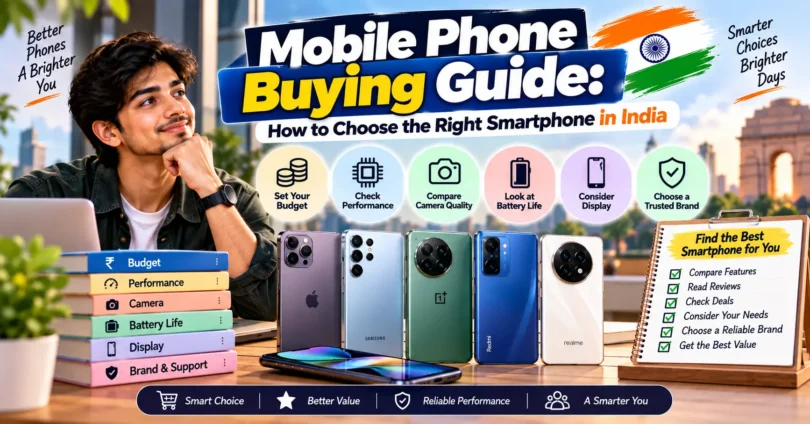

Mobile Phone Buying Guide is designed to help you choose a smartphone based on the features that actually matter instead of simply buying the newest or most advertised model. With phones available across budget, mid-range, premium, gaming, camera-focused, and productivity categories in India, understanding your requirements before spending money can prevent an expensive mistake.
The right mobile phone should match how you use it every day. A student may prioritize battery life and affordability, while a gamer may care more about processor performance, cooling, display refresh rate, and RAM. Someone who frequently creates photos and videos may value camera quality and storage more than gaming performance.
This guide explains the important factors to compare, including budget, processor, RAM, storage, display, cameras, battery, charging, software, 5G connectivity, durability, and long-term support.
What Should You Check Before Buying a Mobile Phone?
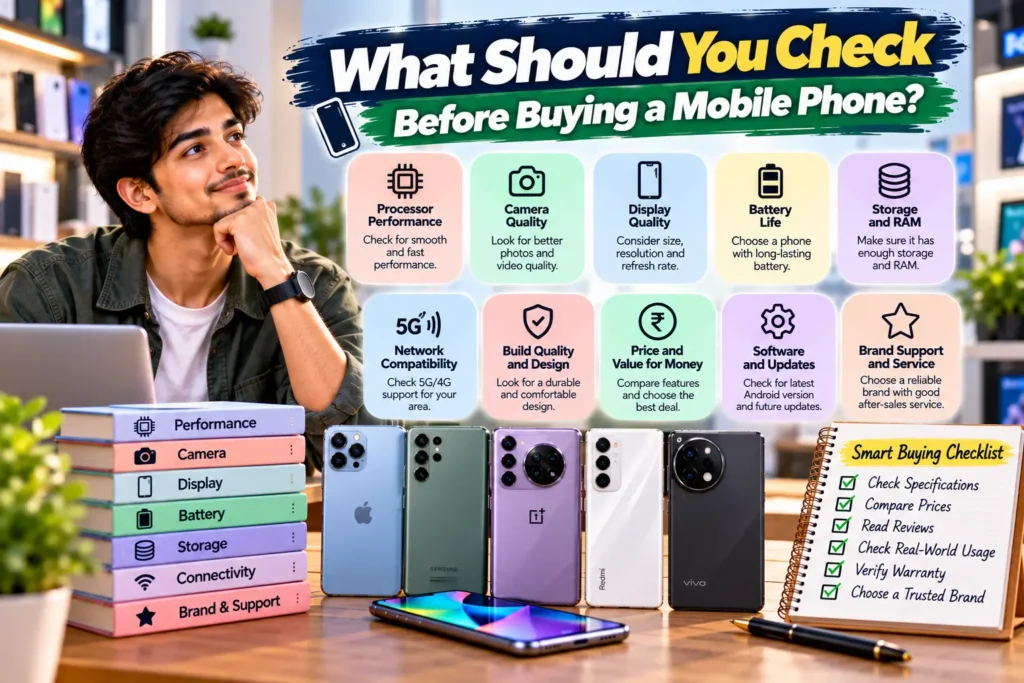
Before buying a smartphone, check your budget, processor, RAM, storage, display quality, camera performance, battery capacity, charging speed, software support, connectivity, durability, and after-sales service.
Do not choose a phone because of one impressive specification. A 200MP camera, huge RAM figure, or extremely fast charger does not automatically make a smartphone better overall.
A good phone provides a balanced combination of performance, reliability, battery life, software, display quality, and useful features within your budget.
Decide Your Budget First
Your budget should be the first decision because it immediately narrows down hundreds of smartphone options.
Instead of deciding on one exact amount, create a reasonable price range. For example, someone planning to spend around ₹20,000 can compare devices slightly below and above that price if the additional cost provides a meaningful improvement.
Indian smartphone buyers can broadly consider these categories:
| Price Range | Suitable For | Features to Prioritize |
|---|---|---|
| Under ₹10,000 | Basic users | Battery, calling, storage |
| ₹10,000–₹20,000 | Everyday users | 5G, display, battery, performance |
| ₹20,000–₹30,000 | Balanced users | Better processor, camera, AMOLED |
| ₹30,000–₹50,000 | Power users | Premium cameras, performance, build |
| Above ₹50,000 | Premium buyers | Flagship cameras, chips, displays and features |
These are practical shopping categories rather than strict rules. Discounts and new launches can move particular phones between value segments.
Avoid Paying for Features You Will Not Use
A flagship processor might be valuable for gaming, video editing, or demanding applications, but unnecessary for someone mainly using WhatsApp, YouTube, UPI apps, calls, browsing, and social media.
Identify your top three requirements before comparing models. This makes choosing between similarly priced phones much easier.
Check the Processor and Overall Performance
The processor, or system-on-chip (SoC), has a major influence on how fast and responsive a smartphone feels.
Modern phones commonly use chipsets from Qualcomm Snapdragon, MediaTek Dimensity, Apple, Samsung Exynos, and other processor families.
However, the processor name alone does not determine real-world performance. Software optimization, thermal management, RAM, storage speed, and cooling can also affect sustained performance.
What Processor Do You Need?
For basic use, a modern entry-level processor can handle calling, messaging, web browsing, video streaming, and light apps.
For multitasking, photography, editing, and heavier applications, consider a capable mid-range processor.
For demanding gaming, high-resolution video editing, or other intensive workloads, a high-performance chipset and effective cooling system become much more important.
When comparing processors, check independent benchmark results alongside real-world reviews rather than relying only on marketing claims.
Choose the Right RAM
RAM helps your smartphone keep applications available and handle multitasking.
For most buyers, 6GB to 8GB of physical RAM provides a sensible starting point, depending on the operating system, price category, and intended use. Heavy users and gamers may benefit from additional memory.
More RAM is not automatically better if the processor, storage, or software optimization is poor.
You may also see “virtual RAM” or memory expansion advertised. This uses part of the phone’s storage as additional memory and should not be treated as equivalent to physical RAM.
Choose Enough Internal Storage
Storage requirements have increased because apps, games, photos, offline media, and high-resolution videos can consume significant space.
For many buyers, 128GB is a practical starting point. Consider 256GB or more if you regularly record videos, install large games, download movies, or plan to keep the phone for several years.
Also check whether the smartphone offers a microSD card slot. Expandable storage is useful, but many premium devices no longer include it.
Remember that the full advertised storage capacity is not available to the user because the operating system and preinstalled software occupy some space.
Display Quality Matters More Than Resolution Alone
The display is one of the smartphone components you interact with constantly, so its quality can significantly affect everyday experience.
Look at the panel type, resolution, refresh rate, brightness, size, outdoor visibility, and protection.
AMOLED vs LCD
AMOLED and OLED displays can provide deep blacks, excellent contrast, and vibrant visuals because individual pixels can switch off.
LCD displays can still provide good colour reproduction and brightness, particularly on affordable phones.
Do not assume every AMOLED panel is automatically superior to every LCD panel. Panel quality and calibration matter too.
Is a 120Hz Display Worth It?
A higher refresh rate can make scrolling, animations, supported games, and general navigation appear smoother.
A 120Hz display is particularly useful if smoothness matters to you. However, refresh rate can affect power consumption, and the actual experience also depends on software optimization and whether the phone uses adaptive refresh-rate technology.
Check Outdoor Brightness
Peak brightness numbers can be useful, but they are not always directly comparable because manufacturers may measure brightness under different conditions.
For Indian users who frequently use their phones outdoors, real-world sunlight visibility is particularly important.
Don’t Judge a Camera by Megapixels
A higher megapixel count does not guarantee better photos.
Smartphone photography depends on several factors, including sensor quality and size, lens quality, aperture, optical image stabilization, image processing, autofocus, HDR processing, and software tuning.
A well-optimized 50MP camera can outperform a poorly implemented camera with a much larger megapixel number.
Which Cameras Are Actually Useful?
A versatile smartphone camera setup may include:
Main camera: Used for most everyday photography.
Ultrawide camera: Helpful for landscapes, architecture, interiors, and group photographs.
Telephoto camera: Provides optical zoom for distant subjects and portraits.
Front camera: Important for selfies and video calls.
Macro and depth cameras can sometimes be useful, but they should not influence your purchase as much as the quality of the main camera.
If photography is a priority, compare full-resolution samples and independent reviews taken in daylight, indoors, portraits, and low light.
Battery Life Should Match Your Routine
Battery capacity is usually expressed in milliamp-hours (mAh), but capacity alone does not determine battery life.
Processor efficiency, display resolution, refresh rate, network usage, software optimization, brightness, gaming, GPS, and background applications all influence how long a phone lasts.
A phone with a larger battery can sometimes deliver poorer endurance than a device with a smaller but more efficiently managed battery.
For most buyers, all-day real-world battery performance is more meaningful than simply comparing mAh figures.
Check Charging Technology
Fast charging can be convenient if you frequently need to recharge during the day.
However, check whether the compatible charger is included in the box. Some manufacturers sell chargers separately.
Wireless charging is generally found on higher-end devices. Reverse wireless charging can also be useful for accessories such as compatible earbuds, although it should usually be treated as an additional feature rather than a primary buying factor.
Check 5G Support Carefully
For a new mid-range or premium smartphone in India, 5G support is worth considering, particularly if you intend to use the device for several years.
Do not stop at seeing “5G” in the product name. Check whether the device supports relevant 5G bands for Indian networks and whether the exact Indian variant offers the connectivity features you need.
Network experience still depends on your telecom provider, plan, location, signal strength, congestion, and network deployment.
A good smartphone should also provide reliable 4G LTE, Wi-Fi, Bluetooth, GPS, and calling performance.
Software Experience Can Make or Break a Phone
Hardware specifications receive plenty of attention, but software affects your smartphone every day.
Consider the operating system version, user interface, preinstalled applications, advertisements, customization options, privacy controls, update frequency, and manufacturer’s update commitment.
Look at the Update Policy
Longer software support can improve the useful life of a smartphone.
Before buying, check how many major operating-system upgrades and security updates the manufacturer officially promises for that particular model.
Policies can differ between brands and even between devices from the same manufacturer, so verify the model rather than assuming every phone from a brand receives identical support.
Check Build Quality and Durability
A smartphone is carried almost everywhere, making durability important.
Look at frame and back materials, display protection, water and dust resistance, button quality, weight, and overall construction.
Understand IP Ratings
An IP rating indicates tested protection against dust and water under specified laboratory conditions.
For example, premium smartphones may offer ratings such as IP67 or IP68. Some affordable models provide lower levels of splash or dust protection.
An IP rating should not be interpreted as permission to deliberately expose your phone to water. Protection can also decrease as a device ages or suffers physical damage.
Consider Smartphone Size and Weight
A large screen is excellent for movies, gaming, reading, and multitasking, but it also makes a smartphone harder to use with one hand.
Compact phones are easier to carry and operate, although there are fewer compact options in many smartphone categories.
If possible, hold the phone before purchasing. Check whether you can comfortably reach the keyboard, volume buttons, power button, and fingerprint sensor.
Weight is particularly important if you spend several hours using your phone every day.
Check Speakers, Haptics and Call Quality
These features may not look impressive on a specification sheet, but they affect everyday usability.
Stereo speakers can improve gaming and video consumption. Good haptic feedback makes typing and navigation feel more precise.
Also investigate microphone performance, earpiece quality, network reception, and call quality through reliable reviews.
If you use wired headphones, check for a 3.5mm headphone jack because many modern smartphones have removed it.
Look at Security Features
Modern smartphones commonly provide fingerprint recognition, face unlocking, PINs, passwords, and other security options.
Fingerprint sensors can be side-mounted, rear-mounted, or placed underneath the display.
Convenience is important, but security also depends heavily on software support. Regular security patches can help address newly discovered vulnerabilities.
Use a strong screen lock and enable device-finding and account-recovery features after setting up your new phone.
Think About After-Sales Service in India
After-sales support deserves attention, especially if you intend to keep your smartphone for several years.
Before buying, consider whether the manufacturer has accessible authorized service centres in your area. Also investigate warranty terms, repair availability, spare-part availability, and typical repair costs for expensive components such as displays.
A slightly cheaper smartphone may become less attractive if getting reliable service is difficult where you live.
Online vs Offline: Where Should You Buy?
Both options have advantages.
Online marketplaces can provide convenient comparisons, exchange programs, bank discounts, and seasonal sales.
Offline stores allow you to physically inspect the phone, test its size, compare displays, and ask questions before purchasing.
Whichever method you choose, buy from an authorized or reputable seller, check the warranty, verify the exact model and storage variant, and keep your invoice.
Should You Buy a New or Previous-Generation Phone?
A previous-generation smartphone can offer excellent value after its successor launches, particularly in premium categories.
However, check how much software support remains.
Also compare the older flagship with newer mid-range alternatives. The older premium phone may provide better cameras, materials, speakers, and processing power, while a newer mid-range device may offer a newer battery, longer remaining support, and updated connectivity.
The better choice depends on your priorities.
Common Mobile Phone Buying Mistakes
One of the biggest mistakes is choosing a smartphone based on a single specification.
Other common mistakes include:
- Buying based only on megapixel count
- Assuming more RAM always means better performance
- Ignoring software update policies
- Paying extra for features you rarely use
- Ignoring storage requirements
- Forgetting to check charger availability
- Choosing an uncomfortable phone size
- Ignoring after-sales support
- Comparing processors only by marketing names
- Buying immediately at launch without comparing alternatives
Taking even 20–30 minutes to compare specifications and reliable reviews can make your purchase more informed.
A Simple Mobile Phone Buying Checklist
Before placing your order, confirm these points:
- Set your maximum budget.
- Decide your three most important features.
- Compare processors and real-world performance.
- Choose sufficient physical RAM and internal storage.
- Check display type, brightness and refresh rate.
- Review real camera samples rather than megapixels alone.
- Check real-world battery performance and charging.
- Confirm 5G and other connectivity requirements.
- Verify the manufacturer’s software-update commitment.
- Check durability, warranty and service availability.
- Compare prices from reputable online and offline sellers.
- Read independent long-term or detailed reviews when available.
This approach reduces the chance of paying for features that look impressive on paper but provide little practical benefit.
Frequently Asked Questions
1. How do I choose the best mobile phone in India?
Start by setting a budget and identifying your main use case, such as photography, gaming, study, work, or general daily use. Compare the processor, physical RAM, storage, display, cameras, battery life, software support, 5G compatibility, durability, and after-sales service. Avoid choosing a phone based on one specification alone.
2. How much RAM is enough for a smartphone?
For many modern smartphone users, 6GB to 8GB of physical RAM is a practical range for everyday multitasking, although requirements vary by operating system and usage. Heavy gamers and power users may benefit from additional RAM. Virtual RAM should not be considered equivalent to physical memory when comparing devices.
3. Is 128GB storage enough for a mobile phone?
128GB can be sufficient for users who primarily browse, stream content, use social apps, and take a moderate number of photos. Consider 256GB or more if you record lots of high-resolution video, install large games, store offline movies, or expect to use the phone for several years without regularly moving files elsewhere.
4. Is a 5G phone worth buying in India?
5G support is useful for buyers who plan to keep their smartphone for several years or already have suitable network coverage. However, connectivity quality depends on the network operator, location, device compatibility, and signal conditions. Check the exact Indian model’s supported bands rather than relying only on a general “5G” label.
5. What is the most important feature when buying a smartphone?
There is no single most important specification for everyone. The best approach is to prioritize features according to your usage. Gamers may prioritize processor performance and cooling, photographers may focus on camera quality, and frequent travellers may value battery endurance. Most buyers benefit from a balanced combination of performance, display, battery, storage, software, and support.
Conclusion
A useful Mobile Phone Buying Guide should help you look beyond advertising numbers and understand how a smartphone will perform in everyday life. Start with your budget, identify your main use cases, and then compare processor performance, RAM, storage, display quality, cameras, battery life, charging, connectivity, software support, durability, and service availability.
Do not automatically buy the phone with the biggest battery, highest megapixel camera, most RAM, or fastest advertised charging. A balanced smartphone that performs well in the areas you actually use is usually a smarter purchase.
Before buying, shortlist two or three models within your budget, compare their specifications, check independent real-world reviews, verify current pricing and warranty conditions in India, and choose the device that best matches your needs.