

Best Smartphones are not simply the phones with the highest price tags or the longest specification sheets. The right smartphone is one that delivers the performance, camera quality, battery life, display, software experience, and useful features that match your actual needs and budget.
India’s smartphone market offers choices across almost every price range, from affordable everyday devices to premium flagships. That variety is useful, but it can also make choosing a phone confusing. Two smartphones at a similar price may focus on completely different strengths: one may offer better gaming performance, while another prioritises cameras, battery life, or software support.
This guide explains how to identify the best smartphone for your needs without getting distracted by marketing terms. You will learn what matters when comparing processors, RAM, storage, cameras, displays, batteries, charging, 5G support, software updates, durability, and long-term value.
What Makes a Smartphone One of the Best?
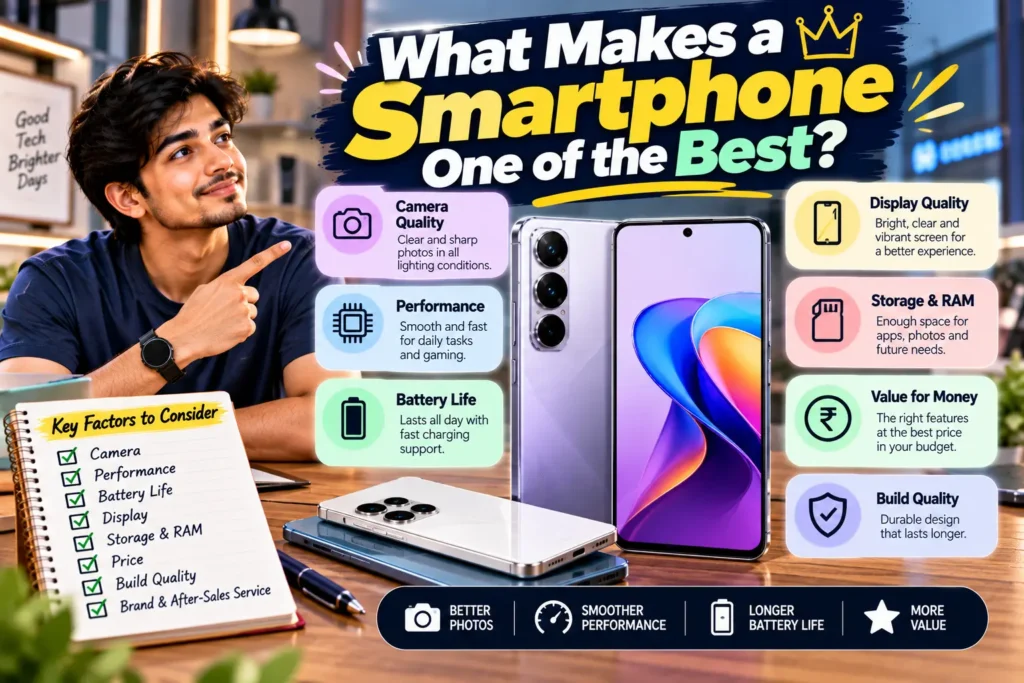
The best smartphone provides a balanced experience in the areas that matter most to its user. Strong specifications are useful, but optimisation, software quality, battery efficiency, build quality, and long-term support can be equally important.
A good smartphone should ideally provide:
- Smooth performance for your everyday applications
- Reliable battery life
- A clear and responsive display
- Sufficient RAM and internal storage
- Dependable cameras
- Stable software
- Useful connectivity features
- Reasonable software and security support
- Good overall value for its price
Your priorities should determine which features receive the most attention.
For example, a student may prioritise battery life, storage, and affordability. A mobile gamer may care more about processor performance, cooling, refresh rate, and touch response. A content creator may place camera quality, video recording, storage, and display accuracy higher on the list.
Best Smartphones by User Type
There is no single smartphone that is ideal for every buyer. A more practical approach is to choose a phone based on how you plan to use it.
| User Type | Features to Prioritise |
|---|---|
| Students | Battery, storage, display, affordability |
| Gamers | Powerful chipset, cooling, high refresh rate |
| Photographers | Camera processing, main sensor, OIS, telephoto options |
| Content creators | Video quality, storage, microphones, cameras |
| Business users | Security, software support, battery, reliability |
| Casual users | Battery, display, cameras, easy software |
| Heavy users | Performance, RAM, storage, thermal management |
This approach prevents you from paying extra for features you may rarely use.
Set Your Budget Before Comparing Smartphones
Setting a realistic budget is one of the most important steps when searching for the Best Smartphones in India. It immediately reduces the number of options you need to compare.
Instead of choosing the cheapest phone available, consider the total value you receive for your money. Spending slightly more can sometimes provide significantly better storage, cameras, software support, display quality, or performance.
At the same time, moving into a premium price category does not automatically mean every feature will improve proportionally.
Consider Your Actual Requirements
Before shopping, write down your five most important requirements.
For example:
- Strong battery life
- 256GB storage
- Good main camera
- Smooth everyday performance
- Reliable software updates
You can then eliminate devices that fail your important requirements, even when they look attractive on paper.
Choose the Right Smartphone Processor
The processor, or system-on-chip, is one of the biggest factors affecting smartphone performance. It influences application speed, gaming, camera processing, connectivity, artificial intelligence features, and power efficiency.
Popular smartphone chip families include Qualcomm Snapdragon, MediaTek Dimensity, Apple A-series, Samsung Exynos, and Google Tensor.
However, you should not choose a phone based only on the processor brand.
What Should You Check in a Processor?
Look at the specific chipset model and its performance category. Chipsets from the same manufacturer can have dramatically different capabilities.
For everyday activities such as WhatsApp, browsing, social media, streaming, UPI payments, and calling, you usually do not need flagship-level processing power.
More demanding users should pay closer attention to sustained performance. Gaming, video editing, emulation, high-resolution recording, and intensive multitasking can put considerably more pressure on the chipset.
Thermal management also matters. A powerful processor that frequently becomes too warm and reduces its performance may provide a worse sustained experience than expected.
How Much RAM Do You Need?
RAM helps a smartphone keep applications available and manage multitasking. More RAM can be beneficial, but RAM capacity alone does not determine how fast a smartphone feels.
For many modern Android buyers, 8GB of physical RAM is a comfortable target when the budget allows. Lighter users may be satisfied with less, while people who frequently switch between demanding applications may benefit from additional memory.
Avoid choosing a smartphone purely because it advertises large amounts of “virtual RAM.” Virtual memory uses storage and is not equivalent to physical RAM.
Software optimisation also influences memory management significantly.
Choose Enough Internal Storage
Storage requirements have increased as smartphone cameras, apps, games, offline videos, and system files have become larger.
For buyers who intend to keep a smartphone for several years, 128GB should generally be considered a practical starting point, while 256GB can be a better choice for users who take many photos and videos, install large games, or store offline media.
Remember that the advertised storage capacity is not fully available to the user because the operating system and pre-installed files occupy some space.
Also check whether the smartphone supports expandable microSD storage if that feature matters to you.
Look Carefully at Display Quality
The display affects almost everything you do on your smartphone. A good screen improves reading, gaming, photography, navigation, streaming, and general everyday use.
Do not judge displays only by resolution.
Important factors include:
- OLED/AMOLED or LCD technology
- Resolution
- Refresh rate
- Outdoor brightness
- HDR capabilities
- Colour reproduction
- Touch responsiveness
- Screen protection
- PWM behaviour if you are personally sensitive to display flicker
Is a 120Hz Display Worth It?
A 120Hz refresh rate can make animations, scrolling, and compatible games appear smoother than traditional 60Hz displays.
However, refresh rate is only one part of display quality. A bright and well-calibrated 90Hz display can sometimes provide a better overall viewing experience than a poorly tuned 120Hz panel.
Adaptive refresh-rate technology can also help balance smoothness with battery efficiency.
Do Not Judge Smartphone Cameras by Megapixels
A higher megapixel number does not automatically produce better photographs.
Smartphone photography depends on the complete imaging system, including sensor characteristics, lens quality, optical image stabilisation, autofocus, image processing, HDR, and computational photography.
A well-optimised 50MP camera, for example, can outperform a higher-resolution camera with weaker optics and processing.
What Camera Features Actually Matter?
For the main camera, look for consistent performance in daylight, indoor conditions, portraits, and low light.
Optical image stabilisation (OIS) can help reduce camera movement and improve results, particularly in challenging lighting conditions and video recording.
If you frequently zoom, check whether the phone has a dedicated telephoto camera rather than relying entirely on digital zoom.
For video, examine supported resolutions, frame rates, stabilisation, microphone quality, autofocus behaviour, and whether switching between cameras during recording is supported.
Camera reviews with full-resolution samples are often more informative than specification sheets.
Battery Life Matters More Than Battery Capacity Alone
Battery capacity is usually expressed in milliamp-hours (mAh), but capacity alone cannot accurately tell you how long a smartphone will last.
Real battery endurance also depends on:
- Processor efficiency
- Display type and brightness
- Refresh rate
- Network conditions
- Software optimisation
- Background applications
- Camera and gaming usage
- GPS and navigation
- Mobile data usage
A smartphone with a smaller battery and efficient hardware can sometimes compete with a phone containing a larger battery.
Consider Charging Speed Too
Fast charging can be extremely convenient, particularly for users who spend long hours away from a charger.
Check the supported wired charging speed and whether a compatible charger is supplied with the phone. Some manufacturers sell chargers separately.
Premium buyers may also want wireless charging and reverse wireless charging, although these features should not outweigh fundamentals such as battery endurance.
Check 5G and Connectivity Features
Most buyers considering a new mid-range or premium smartphone in India should check its 5G capabilities.
Do not focus only on whether “5G” appears in the product name. Check whether the device supports the network bands and technologies relevant to Indian operators and your location.
Other useful connectivity features can include:
- Dual SIM support
- eSIM
- Wi-Fi standards
- Bluetooth version
- NFC
- USB standard
- GPS/navigation systems
- VoLTE and Wi-Fi calling
NFC is particularly useful for compatible contactless functions, while eSIM can be convenient for people who frequently switch carriers or travel.
Software Experience Can Make or Break a Smartphone
Software has a major effect on how enjoyable a smartphone is to use every day.
Different manufacturers use different Android interfaces, while Apple uses iOS on iPhones. Each approach has advantages and limitations.
When comparing Android smartphones, consider:
Software Updates
Check the manufacturer’s official update commitment for the exact model.
Longer operating-system and security support can make a smartphone safer and more useful over a longer ownership period.
Do not assume every phone from the same company receives identical support.
Pre-Installed Applications
Some phones include numerous pre-installed applications or promotional recommendations. Others provide a cleaner software experience.
Many unwanted applications can be disabled or removed, but the amount of pre-installed software can still affect the initial user experience.
AI Features
AI-powered tools are increasingly included in smartphones for photography, transcription, translation, writing assistance, search, and image editing.
Treat these features as extras rather than automatically making them your main buying criterion. Availability can depend on language, region, internet access, software version, account requirements, or subscription terms.
Check Build Quality and Durability
A smartphone should be able to handle normal everyday use without requiring constant attention.
Look at the materials used for the frame and rear panel, display protection, water and dust resistance, button quality, and overall construction.
An official IP rating provides more useful information about tested dust and water resistance than vague descriptions such as “splash resistant.”
Remember that water resistance can decrease with normal wear and repairs, and liquid damage may not necessarily be covered by warranty.
Best Smartphones for Gaming: What Matters?
A gaming smartphone needs more than a fast processor.
For sustained gaming performance, consider the chipset, cooling system, RAM, storage speed, display refresh rate, touch responsiveness, speakers, battery capacity, and charging speed.
A powerful phone can initially deliver high frame rates but lose performance as temperature increases. Therefore, independent sustained-performance and gaming tests are valuable when comparing devices.
Serious gamers should also check whether their favourite games actually support the phone’s advertised high refresh rates.
Best Smartphones for Photography
If photography is your priority, evaluate real camera performance instead of counting cameras or megapixels.
A versatile camera system normally combines a strong main camera with useful secondary cameras.
Prioritise:
- Reliable main camera
- Good dynamic range
- Natural-looking skin tones
- Optical image stabilisation
- Effective night photography
- Useful ultra-wide camera
- Telephoto camera if zoom matters
- Reliable portrait mode
- Strong video stabilisation
Avoid assuming that every additional rear camera adds meaningful value. A strong dual- or triple-camera system can be considerably more useful than a phone with several low-quality auxiliary sensors.
Best Smartphones for Students
Students generally benefit most from balanced and dependable smartphones rather than highly specialised flagship devices.
A student-friendly phone should ideally offer good battery endurance, enough storage for documents and media, a comfortable display, reliable performance, decent cameras, and useful software support.
Durability is also worth considering because the device may be used heavily for several years.
Students who attend online classes should additionally check front-camera quality, microphones, speakers, Wi-Fi reliability, and battery performance during video calls.
Best Smartphones for Everyday Users
For calls, WhatsApp, YouTube, Instagram, browsing, payments, maps, and occasional photography, balanced performance matters more than extreme specifications.
A good everyday smartphone should launch apps quickly, maintain stable network connectivity, provide a bright display, deliver dependable battery life, and capture consistent photos.
Buying an expensive gaming-focused device may provide little practical benefit if you never play demanding games.
Features Worth Paying Extra For
Certain upgrades can improve the long-term experience enough to justify a slightly higher price.
Useful premium features may include OIS, a high-quality OLED display, better speakers, faster storage, stronger build quality, longer software support, an IP rating, better haptics, wireless charging, and a dedicated telephoto camera.
Which upgrades are worthwhile depends on your usage.
A photographer might happily pay more for better cameras, while a heavy traveller may value battery life, eSIM, network support, and durability instead.
Common Mistakes When Buying a Smartphone
One common mistake is comparing phones purely by specification numbers.
A 200MP camera is not automatically better than a 50MP camera. A huge battery does not guarantee the longest battery life. More RAM does not automatically mean faster performance.
Another mistake is buying more performance than you need while compromising on features you use every day.
Also avoid purchasing a phone without checking:
- Exact storage variant
- Official warranty
- Software-update policy
- Charger availability
- Network compatibility
- Service availability
- Independent camera samples
- Long-term performance reviews
Prices and offers can change frequently, so compare current prices from trustworthy retailers and official brand channels before placing an order.
How to Compare the Best Smartphones Before Buying
A structured comparison makes choosing a smartphone much easier.
First, set your maximum budget. Next, identify your three to five essential features. Shortlist phones that satisfy those requirements and then compare their processors, displays, cameras, batteries, storage, software policies, and connectivity.
After narrowing your shortlist, read or watch independent reviews focusing on real-world performance rather than specifications alone.
Finally, compare the current selling price, warranty, available service options, and included accessories.
This process is far more reliable than buying whichever smartphone has the most impressive advertisement.
Frequently Asked Questions
Which are the best smartphones in India?
The best smartphones in India depend on your budget and priorities. Instead of looking for one universal winner, compare devices based on performance, camera quality, battery life, display, storage, software support, connectivity, and durability. Current pricing also matters because discounts can significantly change the value offered by competing models.
How much RAM is good for a smartphone?
For many Android users, 8GB of physical RAM provides a comfortable balance for everyday multitasking, social media, streaming, and many games. Lighter users may need less, while demanding gamers and heavy multitaskers can benefit from more. RAM should be considered alongside processor performance, storage speed, and software optimisation rather than in isolation.
Is 128GB storage enough for a smartphone?
128GB can be enough for users who mainly browse, stream content, use social apps, and store a moderate number of photos. Users who record lots of high-resolution video, download movies, or install large games may prefer 256GB or more. Remember that part of the advertised storage is occupied by system files.
Should I buy a 5G smartphone in India?
For most people buying a new mid-range or premium phone, 5G support is sensible because Indian operators offer 5G services and the phone may be kept for several years. Check supported network bands and your operator’s coverage rather than relying only on a 5G label. Strong 4G performance remains important where 5G coverage is limited.
What should I check before buying a smartphone online?
Verify the exact model, RAM and storage variant, seller details, warranty, return or replacement terms, included accessories, and current price. Compare specifications on the manufacturer’s official product page and use independent reviews to evaluate cameras, battery life, heating, and real-world performance before making the final purchase.
Conclusion
Choosing the Best Smartphones becomes much easier when you focus on your actual requirements instead of chasing the biggest specification numbers.
Start with your budget and decide whether performance, cameras, battery life, gaming, software, or durability matters most. Then compare processors, RAM, storage, display quality, camera performance, charging, connectivity, software support, and build quality.
Before purchasing, verify the specifications and update policy on the manufacturer’s official website, check independent real-world reviews, and compare current prices from reliable sellers. A smartphone that matches how you actually use your device will usually provide better long-term value than one selected purely because it has the most impressive numbers.